
Buying a home is the biggest expense most of us will ever take on. And right at the end, a small three-letter word can quietly add lakhs to the bill: GST.
Most buyers I speak to are not confused about GST because it is complicated. They are confused because no one has explained it to them how GST on buying house / property works. So let me do that here. In this guide, I will walk you through when GST applies to a house and when it does not; the current 2026 rates; why “5%” is not really charged on the whole price; how much you actually pay on a real 2 crore home; the hidden costs that rarely get mentioned; and whether you can genuinely reduce the GST at all.
Let me start with a small story, because it is a mistake I see often. A buyer finds a flat he loves. The builder says, “Sir, the flat is 62 lakh.” He is happy. Then the builder adds, almost casually, “Plus GST, of course. That comes to about 69 lakh.” Suddenly the number had jumped by 7 lakh, and he almost paid it without a question. Here is what I want you to take away: GST on a home is real and legal, but the rate is fixed by the government, not by the builder. Once you know the correct number, no one can put a wrong figure in front of you.
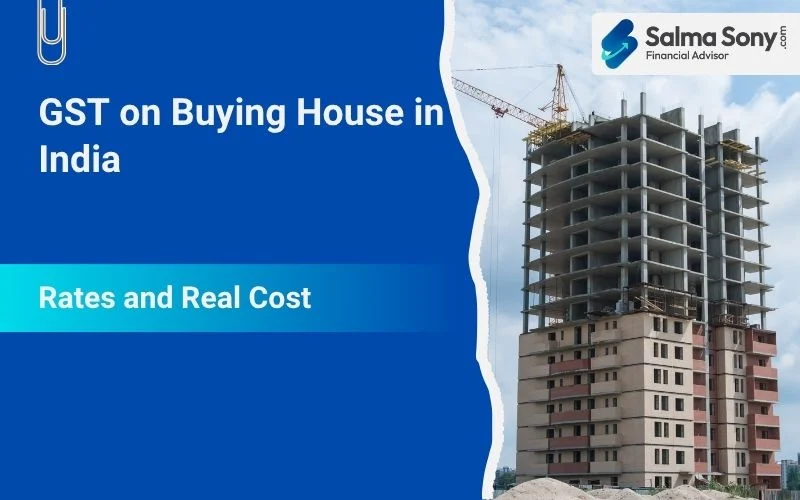
What is GST on Property Purchase in India
Let me give you the one idea that clears up almost all the confusion.
GST (Goods and Services Tax, the single tax that replaced many older taxes in 2017) does not apply to “property” as a whole. It applies only to the construction service.
I like to explain it this way. You are not being taxed for owning land or walls. You are being taxed for the builder’s service of building your flat. That single idea explains everything that follows:
- If the home is still being built, GST applies.
- If the home is finished and ready, GST does not apply.
Be mindful of one more thing. The GST on residential property purchase is the same across all of India. It does not change between Mumbai, Pune, or Kochi. What changes from state to state is stamp duty, which is a completely separate charge. So if anyone tells you “GST is higher in our state,” that is simply not correct. Understanding GST on property buying is the right first step before even planning for a home purchase.
GST Rates on Buying a House in India (2026)
Here are the current rates I want you to keep handy.
| Type of Property | GST Rate | The Key Condition |
|---|---|---|
| Affordable home, under construction | 1% (no input tax credit) | Price up to ₹45 lakh AND carpet area up to 60 sq m in metros and 90 sq m in non-metros |
| Other home, under construction | 5% (no input tax credit) | Anything above ₹45 lakh or larger in size |
| Commercial property, under construction | 12% (with input tax credit) | Shops, offices |
| Ready-to-move home (has completion certificate) | 0% | The single biggest saving |
| Resale home | 0% | Only stamp duty and registration fees apply |
| Plot or land | 0% | Only stamp duty and registration fees apply |
Do not let the phrase “input tax credit” worry you. When a builder buys cement, steel, and paint, he pays GST on all of it. Input tax credit is simply his way of subtracting that tax he already paid from the tax he collects from you, so the same thing is not taxed twice.
For homes, the government made a swap in 2019: a lower rate (5%, or 1% for affordable homes) but no more credit for the builder. So “5% without input tax credit” only means the builder pays 5% and cannot claim back the tax on his materials. For you as a buyer, nothing here needs calculation. The only number in your pocket is that flat 5% (or 1%). The rest is a note for the builder, not for you.
Also Read: 8 Ways: How to Save Tax on Rental Income in India – Maximize Tax Savings
GST on Flat Purchase in India in 2026 (and the GST 2.0 update)
In September 2025, the government ran a large property tax revision that people call “GST 2.0.” Many of my clients asked me whether it would change the cost of a flat purchase. It did not.
The GST rate on flat purchase stayed exactly the same: 1% for affordable and 5% for other residential properties. What did change is that cement dropped from 28% to 18%. That lowers the builder’s cost, which may ease prices a little over time.
GST on Under-Construction Property in India
This is where GST actually bites. If you book a property that is still being built, you pay 5% (or 1% if it is affordable).
I want you to be careful here. It does not matter if the builder says “only three months of work is left.” Until the building receives its completion certificate, it counts as under-construction property, and GST is applicable. So before you accept any GST figure, the first thing I suggest you confirm is simple: does the project have its completion certificate yet or not?
GST on Flats Below 45 Lakhs
If you are buying your first home, GST can quietly stretch your budget, so let me clear up a common misunderstanding.
A new flat below 45 lakh is not automatically “affordable.” Both conditions must be met: the price up to 45 lakh AND the carpet area within the limit (60 sq m in metros and 90 sq m in non-metros). Meet both, and you pay just 1%. Miss the size limit, and it becomes 5%, even below 45 lakh.
GST on Ready-to-Move Flat
This is the most valuable, least-known point I want to share if you’re buying a flat: a ready-to-move flat has zero GST. Nothing.
If the builder has the completion certificate or occupancy certificate and is handing over possession, you are exempt from GST. You only pay stamp duty and registration. If GST is a real strain on your budget, this is the door I would ask you to look at first.
GST on Affordable Housing
Affordable housing is the only category in the real estate sector where you legally pay just 1%. But I have seen builders misuse it.
If a builder quotes 1% on a 55 lakh flat, that should stop you, because such a flat cannot qualify. So before you accept any 1% quote, always check both the price and the carpet area yourself.
Before you fall in love with any flat, I want you to take one honest step back. A home is not just a purchase. It is the biggest financial decision of your life, and GST is only one line in it. In my experience, the right first move is a plan, not a property. Sorting out your budget, your emergency fund, and your loan comfort first is exactly what my financial planning services are built to help you do, so the home you buy actually fits your life.
Is GST Charged on the Land Too? (5% vs 7.5%)
This is the question that confuses almost everyone, so let me make it dead simple.
GST is meant to apply only to construction, not to land. The government knows land is a big part of any home’s value. So the law assumes land is one-third (33%) of the price and removes it before taxing.
Here is the math in one line. The real rate is 7.5%, but it applies to only two-thirds of the value after removing the land part, and 7.5% on two-thirds works out to 5% of the full price. So when a builder says “5% on the agreement value,” the land deduction is already inside that number. You are not being taxed on the land separately.
Even so, I suggest you always ask the builder for a written breakup showing the base price and the GST. It costs you nothing, and it prevents any confusion later.
How GST is Calculated on a House Purchase (Real Examples)
Numbers make this real, so let us work through a couple.
Example 1: An 80 lakh under-construction flat (not affordable).
- GST at 5% is 4 lakh.
- Stamp duty at, say, 6% is 4.8 lakh.
- Registration at about 1% is 80,000.
- Total taxes and charges cross 9.6 lakh.
Example 2: A 42 lakh affordable flat.
- GST at 1% is just 42,000.
- The category alone changes your GST bill dramatically.
One thing buyers forget: if you add that 4 lakh GST into your home loan, your EMI can rise by about 1,500 to 2,000 rupees every month. So GST is not a one-time sting. It can quietly ride your loan for 20 years.
Also Read: How to Invest in REITs in India: A Comprehensive Guide
Case Study: Under-Construction vs Ready-to-Move (a real 2 crore comparison)
Let me show you the comparison most buyers never sit down and do. Take Rahul and Ananya (a random couple), a dual-income household in Mumbai. They have a 20% downpayment ready, which is 40 lakh, and they are looking at a 2 crore home. The question they brought to me was simple: should they buy under construction or ready to move in?
Here is how the taxes stack up on the same 2 crore home.
| Cost | Under-construction 2 Cr | Ready to move: 2 Cr |
|---|---|---|
| GST | 5% = 10,00,000 | 0 |
| Stamp duty (say 6%) | 12,00,000 | 12,00,000 |
| Registration | ~30,000 | ~30,000 |
| TDS (1%, part of price, not extra) | 2,00,000 | 2,00,000 |
| Extra tax vs the other option | +10,00,000 (the GST) | Nil |
Look at that last row carefully. On the same 2 crore home, the under-construction option costs about 10 lakh more, purely because of GST. Stamp duty, registration, and TDS are identical for both. The only real tax difference is the GST, and their 40 lakh down payment does not change that. On the under-construction flat, the 10 lakh GST simply gets collected in parts as they pay the builder. On the ready-to-move flat, it does not exist.
There is one honest catch I always mention. Ready-to-move flats often carry a slightly higher sticker price because the builder has to pay GST on unsold flats to get the completion certificate and quietly builds that into the price. So you may not save the full 10 lakh or may pay much more than this if the property is from a renowned builder (depending on supply and demand post-construction). But by removing the visible GST, you get a home you can move into today with no construction risk. However, if you plan to fund the house mainly with a loan, an under-construction property gives you additional time to arrange funds; hence, you save a lot of interest by accessing a lower loan amount.
GST Is a Government Rule, not a Builder Charge (But Watch the Rate)
Let me be fair here, because this matters. GST is not a builder scam. It is a genuine central government tax, and the builder only collects it and passes it on. If you buy under construction, you will pay GST, and that is completely correct.
The real problem is not GST itself. It is when a builder quotes the wrong rate or hides behind jargon. Two mistakes I want you to watch for:
- The 12% quote on a home. One buyer was quoted 12% on a residential flat and nearly overpaid by 5 to 7 lakh. 12% is only for commercial property like shops and offices. Your home is 5% or 1% if affordable.
- The “GST included” switch. The brochure says “price includes GST.” The agreement says GST is extra. Always trust the signed agreement, not the advertisement.
So here is what I suggest you do. Ask the builder for the GST number (GSTIN), check it on the government GST portal, and ask for a proper GST receipt with a signature, a stamp, and a clear breakup. A builder who is genuinely depositing your GST will have no problem showing you this.
The Hidden Costs Nobody Budgets For (the Full Tax Stack)
GST is only the part you can see. Let me now walk you through the rest of the tax structure, because this is where budgets usually go wrong.
TDS on Property Purchase: Is It Really Extra?
TDS on property purchase is not extra, and this trips up a huge number of buyers.
For any property of 50 lakh or more, the rule (Section 194-IA) says you must hold back 1% of the price and deposit it with the Income Tax Department as TDS (tax deducted at source, which simply means tax taken out at the time of payment). This 1% comes out of what you pay the builder, not on top of it.
Take Vikram, buying a 1 crore flat. He does not pay 1 crore plus 1 lakh. He pays the builder 99 lakh and deposits 1 lakh as TDS. The total is still 1 crore. Some smaller builders wrongly ask you to pay the full amount and the TDS separately. That is not correct, and if a builder does this, I suggest you quote Section 194-IA to them.
Stamp Duty and Registration Charges
These are state government charges, and they apply to every home, even ready-to-move and resale. Stamp duty is usually 4% to 8% depending on your state. Registration is about 1%, or a fixed amount in some states. These are unavoidable, so budget for them from day one.
The Extras, and Their GST
Builders also collect club membership, parking, preferential location charges (a premium for a better floor or view), and infrastructure charges. When these are collected before you get possession, they are treated as part of the construction service and taxed at the same 1% or 5% as your flat. Some standalone charges can attract 18%.
So the full picture usually looks like this: base price, plus GST, plus stamp duty (4 to 8%), plus registration (about 1%), plus these extras. Together, taxes and charges can easily cross 8 to 10% of the price. On a 1 crore home, that is 8 to 10 lakh, which you must plan for in advance.
The 18% GST on Maintenance Charges Nobody Warns You About
This one surprises people, because it comes after you have moved in.
The GST on maintenance charges is 18%, but only if two conditions are both met:
- Your maintenance is more than 7,500 rupees per month.
- AND your society’s yearly collection crosses 20 lakh. In most city apartments, both are crossed.
It goes a little further. The money your society collects for future repairs, called the sinking fund or corpus fund, is also taxed as a “service,” with no credit to claim back. So this is a recurring cost for as long as you own the flat, and it is heaviest in amenity-rich societies and older resale buildings with big repair needs. My suggestion is to check the maintenance structure before you buy, not after.
Can You Legally Save GST on a Flat? (the honest answer)
Let me be completely straight, because this is where a lot of articles give false hope.
If you are buying an under-construction flat, you cannot legally avoid GST. If your CA told you this, your CA is right. The tax is fixed, the builder must collect it, and there is no clever loophole or form that makes it disappear. Anyone promising a “trick” to dodge it is not being honest with you.
What you can genuinely do is choose a situation where GST is lower or zero:
- Buy ready-to-move or resale (0% GST). This is the only real way to pay no GST. The honest catch, as we saw, is that the price may already absorb some of it.
- Qualify for affordable housing (1%). A legitimate lower rate, not a dodge, if your flat truly meets the price and size limits.
- Negotiate with the builder to absorb the GST. In a slow market, you can say, “I am fixing the final price; you handle the GST.” This does not remove the tax; it only shifts who pays it. Builders sometimes agree.
So if you ask me – How to avoid GST on flat purchase? The honest answer is you cannot avoid GST on an under-construction flat, but you can choose ready-to-move to sidestep it or affordable housing to reduce it.
GST for Dual-Income Couples, Business Owners and NRIs
Your situation changes what you should watch for.
Dual-income couples. Your biggest risk is under-budgeting. The full tax stack (GST, stamp duty, registration, TDS) can be 8 to 10% on top of the price, so build that in before you fall in love with a flat. Joint ownership does not change GST, but in some states, having a woman as a co-owner can reduce stamp duty and may also help with home loan tax benefits.
Business owners and self-employed buyers. If you buy a commercial unit, the rate is 12%, but with input tax credit, which changes the math. Your loan processing costs can also be higher. This is worth a proper sit-down before you commit.
NRIs. The good news first: your GST is exactly the same as a resident’s. There is no separate NRI rate, and no NRI exemption either. The real complexity for you sits elsewhere: the 1% TDS, moving money into India correctly, and fitting this purchase into a financial life spread across two countries. This is where good advice saves you from expensive mistakes made from far away.
Financial Planning for Home-Buyers: Where GST Fits In
Let me ask you to step back and see the whole picture. GST feels like the villain, but it is only one line in the biggest purchase of your life. The real question is not “what is the GST on buying a house.” It is, “Does this entire home, with all its costs, fit my financial plan?”
The way I suggest you approach it is simple:
- Work out your true all-in cost: base price, GST, stamp duty, registration, TDS, and the extras.
- Check your emergency fund so the house does not leave you cash-poor.
- Consider working towards other important goals like child education and retirement corpus side by side; do not leave it for later.
- Size the loan to your home purchase needs, not to the maximum the bank offers.
A beautiful home bought on a shaky plan is still a mistake. Before you sign anything, it is worth seeing how this purchase affects your goals, your loan comfort, and your long-term wealth. That full-picture clarity is exactly what my financial planning services are meant to give you, so you buy with confidence instead of anxiety.
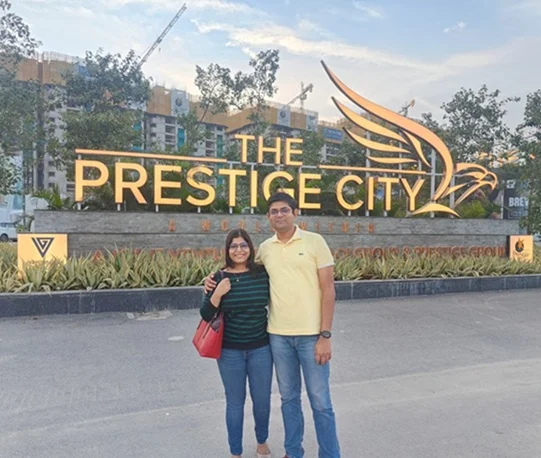
My Experience: GST on Buying Under-construction Flat
Last year, my spouse and I decided it was finally time to buy a house as our finances were ready for this big step, so we explored properties and shortlisted Mumbai, Hyderabad, and Goa. And, realized that each state has its own way of presenting property costs.
Mumbai: When they quoted, it included GST & registration
Hyderabad: GST was included, and registration was over and above
Goa: A slow city; it took very long, and by that time we had already finalized.
Most people are in a hurry to buy a home. We took a different approach. We focused on building our corpus, planned carefully, and consciously opted for an under-construction property.
We were comfortable paying GST because we believed the city is developing rapidly and there is strong demand for property. More importantly, the expected delivery timeline aligned well with our retirement plan. Choosing an under-construction property also gave us something valuable: time – almost three years which helped us to fund the property and plan for the interiors without taking a loan.
If you are exploring properties across multiple cities, my biggest suggestion is this: ask the builder for a complete cost breakup. It should clearly show the property value, GST, TDS, registration charges, and stamp duty.
That’s exactly what we did, and it helped us plan every penny without unpleasant surprises later.
And one more thing: if you are looking for really good interiors, don’t underestimate the cost. As a rule of thumb based on our experience, consider keeping around 15%–25% of the property value aside for interiors, depending on your preferences and the level of customization you want.
Buying a home is a huge financial decision. Taking your time, understanding the complete cost, and planning the cash flow can make the journey much less stressful.
Also Read: Learn Your Objective of Investment- For Better Investment Planning
The Bottom Line
GST on buying a house is simpler than builders make it sound. Under-construction homes pay 1% or 5%. Ready-to-move and resale homes pay nothing. The “5%” already excludes land. And you genuinely cannot dodge GST on an under-construction flat, so I would not chase tricks. Plan for the cost instead.
If you are buying under construction, budget the full 5% and the wider tax stack from the start. If you want to skip GST entirely, look seriously at ready-to-move homes. And if you are an NRI or a dual-income couple stretching for a big home, get the numbers checked before you sign, not after.
The right first step is not to book the flat. It is to understand your full financial picture first: your emergency fund, the GST sitting inside your home loan, and whether this purchase weakens your long-term goals. Buying a home should move you closer to your goals, not away from them. Get that clarity first, and the rest becomes far easier.
FAQs: GST on Buying House
Q-1: What is the GST rate for buying a residential house in India?
For an under-construction home, GST is 5%, or 1% if it qualifies as affordable housing (up to 45 lakh and within the carpet-area limit). For a ready-to-move home with its completion certificate, and for any resale home, GST is 0%. Commercial property is higher, at 12%. So the rate depends entirely on whether the home is still being built or is ready.
Q-2: Is there GST on property above 50 lakh?
Yes, if it is under construction. Any flat above 45 lakh cannot be “affordable,” so you pay 5%. But that same flat, if it is ready to move in with a completion certificate, has zero GST. The construction status decides GST, not the price.
Q-3: How do I calculate GST on a property purchase in India?
Take 5% of the agreement value for a normal under-construction home, or 1% if it is affordable. For example, on an 80 lakh under-construction flat, GST at 5% is 4 lakh. The 5% already accounts for the land portion, so you are not paying extra for the land separately.
Q-4: Is GST charged on ready-to-move or resale flats?
No. If the builder has received the completion or occupancy certificate, a ready-to-move flat has zero GST, and a resale flat has zero GST too. In both cases, you only pay stamp duty and registration charges. This is the single biggest way to legally avoid GST on a home.
Q-5: Is GST charged on the land value of a flat?
No, not directly. The law assumes land is one-third of the value and removes it before taxing. That is why the real 7.5% rate becomes an effective 5% on the full price. So when a builder says “5% on the agreement value,” the land has already been excluded.
Q-6: When do I actually pay the GST, at booking or registration?
You pay it in parts, along with each payment you make to the builder as construction progresses, not in one shot at registration. If you pay the full amount upfront before the building is complete, the builder can collect the full GST at that point.
Q-7: Is the 1% TDS an extra cost on top of the price?
No. For a property of 50 lakh or more, 1% TDS is deducted from the amount you pay the builder, not added on top. On a 1 crore flat, you pay the builder 99 lakh and deposit 1 lakh as TDS. Some builders wrongly ask for it separately, so clarify this before booking.
Q-8: Can I legally avoid paying GST on an under-construction flat?
Honestly, no. If you buy under construction, GST is unavoidable, and your CA is correct to tell you so. The only legitimate ways to pay less or nothing are to buy a ready-to-move or resale home (0% GST) or to qualify for affordable housing (1%). Anyone promising a trick to dodge it is misleading you.
Q-9: Why is there 18% GST on my society’s maintenance?
Because the government treats society maintenance as a service. It applies at 18% only if your maintenance is above 7,500 per month per flat AND your society collects more than 20 lakh a year. Both conditions must be met, but in most city apartments, they are. Even the sinking fund for future repairs gets taxed this way.
Q-10: Do I pay GST if I buy a plot and build my own house?
Buying the plot itself has no GST. If you then hire a contractor to build, you pay about 18% GST on their construction service. If you hire labor directly and buy materials yourself, there is no GST on the labor, only the normal GST already included in the prices of cement, steel, and tiles. The 1% and 5% rates apply only to builder-sold flats.
Q-11: Are there any GST exemptions for first-time home buyers?
There is no special GST exemption just for being a first-time buyer. The closest relief is the 1% affordable-housing rate, if your home qualifies on price and size. Beyond that, the way to pay zero GST is to choose a ready-to-move or resale home, which anyone can do, first-time buyer or not.