

Every month, without you doing anything, 12% of your basic salary leaves your account and goes into your EPF – your Employee Provident Fund. Your employer adds another 12% on top of that. It happens automatically. Quietly. And for most working Indians, that one fact becomes the reason they never think about retirement again.
“My EPF is running. I’m covered.”
Here’s the truth nobody tells you early enough: EPF alone will not fund the retirement you’re imagining.
Think about it this way. EPF grows at around 8% per year, and it’s tied entirely to your employment. The moment you switch jobs, take a break, or become self-employed – the contributions stop. And when you finally retire at 60 and look at that corpus, it often covers 5 to 7 years of living expenses at best. If you live until 80 or 85 , which is increasingly common – that leaves a 15 to 20 year gap that EPF simply cannot fill.
That gap is exactly why PPF and NPS exist.
EPF, PPF, and NPS are three completely different things – even though they share abbreviations and get mentioned in the same breath. Here’s the simplest way to understand the difference:
- EPF (Employee Provident Fund) is something that happens to you – your employer sets it up, contributions are mandatory, and you have very little control over it.
- PPF (Public Provident Fund) is something you choose – you open it yourself, you decide how much to put in, and your money grows at a guaranteed government rate, completely tax-free, for 15 years or more. It’s for anyone – salaried, self-employed, business owner, or homemaker.
- NPS (National Pension Scheme) is something you build deliberately – a retirement account where your money is invested in markets (stocks, bonds, government securities), grows at potentially higher rates over the long term, and is specifically designed to give you a financial cushion when you stop working at 60.
Now here is the emotional reality that most people only confront too late.

Imagine you are 58 years old. Two years from retirement. You pull up your EPF balance, and it looks reasonable- ₹1 crore. You feel okay. You even feel proud. Then you do the actual math: your monthly household expenses are ₹60,000
That is ₹7.2 lakh a year. At that rate, ₹1 crore runs out in under 14 years. [When you are 72 years old]
If you live until 80, you need 8 more years of income. The numbers do not add up – not to mention old-age medical expenses.
That moment – the one where you realize your long-term retirement savings won’t last your retirement is the moment this article is written to help you avoid.
PPF gives you a guaranteed, tax-free corpus that you build over 15 to 25 years – completely separate from your job, your employer, and market fluctuations.
NPS gives you a market-linked retirement savings engine that, if started early, can grow into a corpus large enough to actually sustain the life you want after 60 – not just survive it.
So – PPF or NPS? Which one do you actually need? Let’s go through both properly so you can decide.
What Is a Public Provident Fund (PPF)?
The Public Provident Fund, or PPF, is a savings scheme backed entirely by the Government of India. It has been around since 1968 and remains one of the most trusted long-term saving tools in the country.
The interest earned from your PPF account is completely tax-free, making it a favorable option for those planning for retirement or long-term financial goals. The lock-in period of a PPF account is typically 15 years. However, partial withdrawals are usually allowed from the 7th financial year subject to certain rules.
What Is a PPF Account?
A PPF account is a special savings account you open at a bank or post office. You deposit money into it every year, the government pays you a fixed interest rate on the balance, and after 15 years you receive your entire corpus – principal plus interest – completely tax-free.
You can open only one PPF account in your name. The account matures after 15 years, but you have the option to extend it in blocks of 5 years after the initial 15-year period. This is a great option for those nearing retirement, as they can continue parking their money in PPF to keep getting tax-free interest.
Features and Benefits of PPF
- Guaranteed returns at 7.1% per year. The government sets the PPF interest rate every quarter. Right now it stands at 7.1% per annum, compounded annually. This rate doesn’t go up or down with the stock market – what you see is what you get. Your money grows at a steady, predictable pace, year after year.
- No risk to your money. PPF is 100% government-backed. There is no market exposure, no fund manager making decisions, and absolutely no chance of your principal being wiped out. For people who don’t want to worry about market crashes affecting their retirement savings, PPF is the safest retirement investment.
- You can invest between ₹500 and ₹1,50,000 per year. You don’t need a large lump sum to start. You can invest as little as ₹500 in a year and go up to ₹1.5 lakh. Many people invest the full ₹1.5 lakh to maximize the tax benefit under Section 80C if they opt for the old tax regime, but primarily for the compounding benefit.
- Your money is locked in for 15 years – and that’s actually a good thing. PPF has a 15-year lock-in period. This means you can’t withdraw everything before maturity. But this restriction protects you from the temptation of dipping into your retirement savings for short-term wants. After 15 years, you can extend in 5-year blocks and keep earning tax-free interest.
- It is completely tax-free at every stage – EEE status. This is PPF’s biggest advantage. Every rupee you put in is deductible under Section 80C (up to ₹1.5 lakh per year). All the interest your money earns is tax-free. And when you withdraw at maturity, not a single rupee is taxed. This is called EEE – Exempt, Exempt, Exempt. No other mainstream investment in India offers this at all three stages.
- Loan and partial withdrawal options for emergencies. PPF isn’t completely inaccessible. You can take a loan against your PPF balance from the 3rd to 6th year. And from the 7th year onwards, you can make partial withdrawals – up to 50% of your balance – if you need funds for education, medical expenses, or other needs.
Who Can Invest in PPF?
Any Indian resident – salaried, self-employed, business owner, homemaker, or student can open a PPF account. You can also open one for a minor child. NRIs cannot open a new PPF account. If you became an NRI after opening a PPF account as a resident, you may continue contributing until the 15-year maturity but cannot extend it after that.
What Is the National Pension System (NPS)?
The National Pension System, commonly called NPS, is a retirement savings scheme launched by the Government of India in 2004. Unlike PPF, your money in NPS is invested in the financial markets across stocks, corporate bonds, and government securities, depending on the option you choose.
Think of NPS like a retirement mutual fund that is locked away until you turn 60. It has the potential to grow faster than PPF because it invests in markets. But unlike PPF, the returns are not guaranteed; they depend on how the markets perform over time.
The NPS scheme offers two account options: Tier I and Tier II. Tier I necessitates restricting withdrawals until retirement to foster a habit of saving. Contributions made to Tier I accounts are tax-deductible under Sections 80C and 80CCD(1B) of the Income Tax Act. On the other hand, Tier II is voluntary. It allows investors more flexibility in accessing their funds without any associated tax advantages.
Also Read: Exploring The Best Retirement Investment Options in India
National Pension System Benefits and Features
- Market-linked returns with historically strong performance. NPS doesn’t give you a fixed interest rate. Instead, your money is invested by professional fund managers across equity (stocks), corporate bonds, and government securities. Historically, NPS equity-heavy portfolios (called Scheme E) have delivered returns of 10–12% per year over long periods. This is significantly higher than PPF’s 7.1%, which is why NPS tends to build a much larger retirement corpus over 20–30 years.
- You choose how much risk you want. NPS gives you control over where your money goes. You can allocate a larger share to equity for higher growth potential or shift more into government bonds if you prefer safety. You can change this allocation up to four times a year, which means as you get closer to retirement, you can gradually reduce equity exposure and move to safer options.
- No upper limit on how much you can invest. Unlike PPF, which caps you at ₹1.5 lakh per year, NPS has no maximum. If you want to put ₹5 lakh or ₹10 lakh into your NPS account in a year, you can. This makes NPS the only retirement instrument where high earners can park unlimited amounts in a tax-efficient structure to get better returns
- Your money is locked in until age 60. NPS Tier I (the retirement account) does not allow free withdrawal before you turn 60. This strict lock-in is what makes it a genuine retirement tool – the money you put in here is meant to stay there until you retire. This also protects you from accidentally spending your retirement savings on things that feel urgent today but aren’t actually retirement needs.
- Partial withdrawals are allowed for specific life needs. After 3 years of investing, you can withdraw up to 25% of your own contributions for specific approved purposes such as your child’s higher education, a medical emergency, buying a home, or treatment of a critical illness. You can do this a maximum of 3 times over the life of the account.
- At retirement, you get 60% as a lump sum and the rest as a monthly pension. When you turn 60, you can withdraw 60% of your total NPS corpus in one go – and this portion is completely tax-free. The remaining 40% must be used to buy an annuity, which pays you a fixed monthly income (pension) for the rest of your life. The monthly pension is taxable, but it gives you a steady income stream in retirement.
- NRIs can invest in NPS. Unlike PPF, NPS is open to Indian citizens aged 18 to 70, including NRIs. Contributions can be made from an NRE or NRO account.
The New NPS Scheme: Multiple Scheme Framework (MSF)
From October 1, 2025, PFRDA (the NPS regulator) introduced a new structure called the Multiple Scheme Framework (MSF) for non-government subscribers.
Here is what changed, in simple terms:
- You can now invest 100% of your NPS money in equity. Earlier, the maximum equity allocation was capped at 75%. Under MSF, you can go all the way to 100% equity – which is a significant opportunity for younger investors with 20 or more years before retirement.
- You can hold multiple NPS schemes under one account.Earlier, each NPS account was tied to one scheme and one fund manager. Now, you can diversify across multiple schemes and even multiple fund managers – all under the same account number (PRAN).
- You can exit after 15 years instead of waiting until 60. Under MSF, if you have completed 15 years of investment, you have the option to exit – you don’t necessarily have to wait until you turn 60. This gives more flexibility, especially for those who started investing in NPS early and planning for early retirement.
Quick Check:Already have an NPS account? Log in to your CRA portal and check whether you have explored the new MSF options that became available from October 2025. The 100% equity option could significantly change your long-term corpus.
Read More: NPS New Rules 2025: Pension System, Withdrawal Changes from October 1
Who Can Invest in NPS?
Any Indian citizen between 18 and 70 years of age can invest in NPS – including NRIs. Salaried employees, self-employed professionals, freelancers, and business owners are all eligible. There is no employer requirement to open an NPS account on your own.
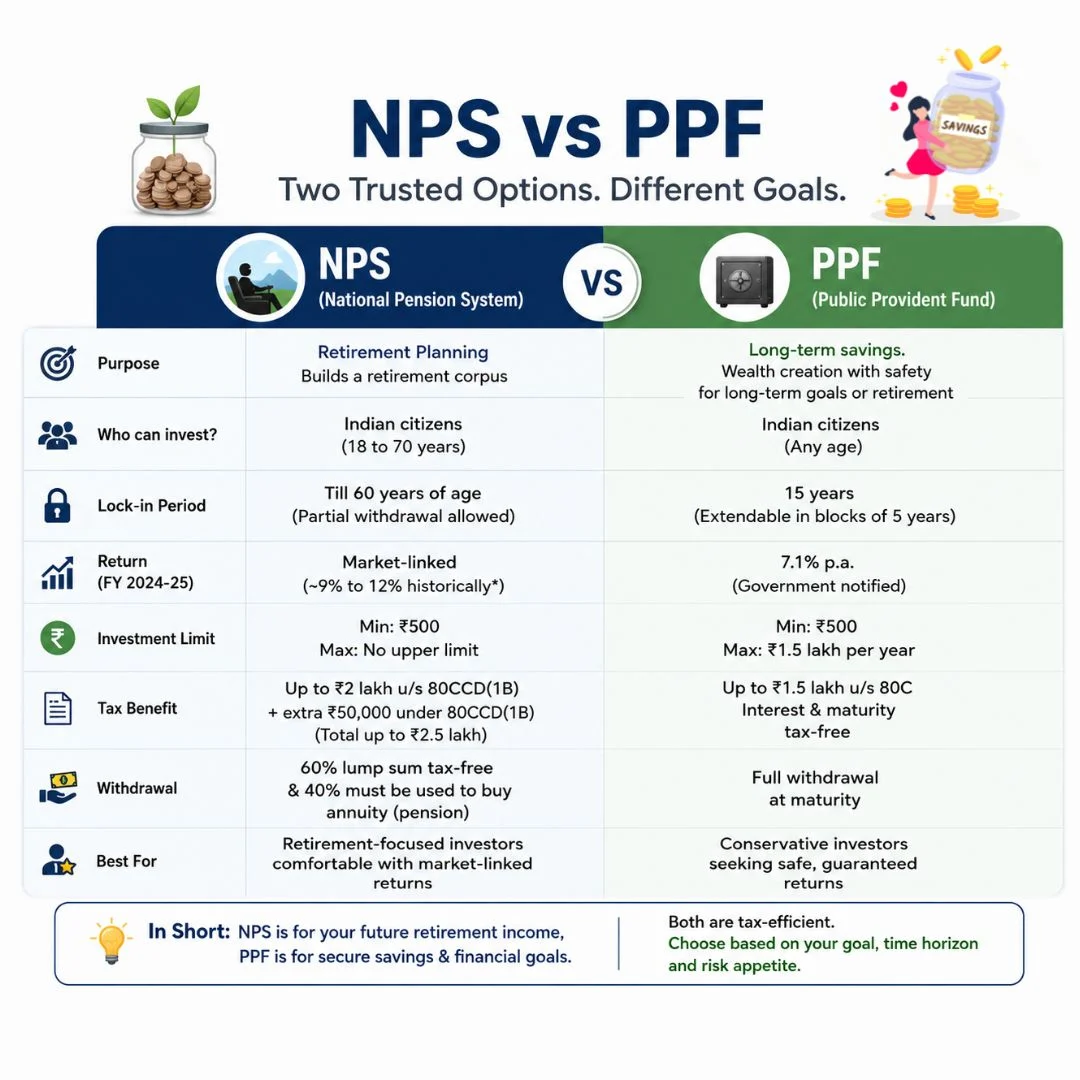
NPS vs PPF Comparison
Before we go deeper, here’s a quick snapshot of how the two compare across the most important parameters:
| Parameter | PPF | NPS |
|---|---|---|
| Returns | 7.1% (guaranteed) | 10–12% CAGR (market-linked, equity option) |
| Risk | Zero – government-backed | Moderate to high (based on allocation) |
| Lock-in Period | 15 years | Until age 60 (Tier I) |
| Minimum Investment | ₹500 per year | ₹1,000 per year |
| Maximum Investment | ₹1,50,000 per year | No upper limit |
| Who Can Invest | Indian residents only | Indian citizens + NRIs (18–70 years) |
| Tax on Contribution | Deductible up to ₹1.5L under 80C | Up to ₹2L total (80CCD(1) + 80CCD(1B)) |
| Tax on Returns | Fully tax-free | 60% lump sum tax-free; 40% annuity taxable |
| Full Corpus Access at Retirement | Yes – 100% | No – 40% must buy annuity |
| Loan Facility | Yes (year 3 to 6) | No |
Example: Rahul’s NPS vs. PPF Investment
Take Rahul, a 35-year-old IT professional in Hyderabad. He decides to invest ₹8,000 every month toward his retirement – that’s ₹96,000 per year. He has 25 years before he turns 60.
If Rahul puts ₹8,000/month into PPF:
- At 7.1% interest over 25 years, his corpus grows to approximately ₹73 lakh
- At retirement: He withdraws the entire ₹73 lakh – fully tax-free, no conditions
- Full freedom to use the money however he wants
If Rahul puts ₹8,000/month into NPS (at 10% CAGR, equity allocation):
- His corpus at 60 grows to approximately ₹1.07 crore
- At retirement: He gets ₹64.2 lakh as a tax-free lump sum (60%)
- ₹42.8 lakh goes into an annuity (40%) – mandatory, no choice
- That annuity pays him roughly ₹2.57 lakh per year at a 6% rate
- But this pension income is taxable at the 30% tax slab; he nets around ₹1.8 lakh/year or ₹15,000/month from ₹42.8 lakh locked away
NPS builds a bigger corpus. But not all of it is as freely accessible as it appears on paper. This is the annuity reality that most comparisons skip over.
Also Read: Life Cycle Fund in India: Smart Retirement Planning with Automatic Asset Allocation
Key Differences Between NPS and PPF
Now that you’ve seen how both work, let’s focus on the differences that actually matter when you’re planning for retirement
- Guaranteed vs. market-linked returns. PPF gives you a government-declared interest rate, which is roughly 7.1% every year, though this can change. NPS invests in equity and debt markets, and the returns are not fixed. In good years NPS grows fast (you can earn 10-12% or more). In bad years, it can underperform.
- Full access vs partial access at retirement.With PPF, when the account matures, you get 100% of the corpus amount With NPS, you get only 60% of the corpus in hand. The remaining 40% must mandatorily be used to purchase an annuity (a pension product). Also, the pension you receive each month from your annuity is taxable. This is the main difference you should consider when deciding between PPF Vs NPS.
- How much you can invest. The maximum investment amount for PPF is 1.5 lakhs every financial year. NPS has no investment limit, which is an advantage if you want to invest large amounts for your retirement.
- Extension option after maturity.After 15 years, PPF can be extended in 5-year blocks with or without continuing deposits and keeps earning 7.1% tax-free. This is a powerful feature that NPS doesn’t have. PPF can become a long-term wealth-building tool even after maturity.
- Flexibility in who can use it.PPF is only for Indian residents. NPS is available to residents and NRIs alike.
Knowing what PPF and NPS are is step one. But knowing how much to put into each – and in which proportion – depends entirely on where you are in life. A 30-year-old with no dependents has a completely different allocation than a 42-year-old who is also saving for a child’s college education in 5 years. The instrument is the same. The financial strategy is not.
Tax Benefits Comparison of NPS vs PPF: Which Is Better?
NPS Tax Benefit for Salaried Employees
Which tax regime works better for you is not a question with a universal answer. It depends on your income, your deductions, your employer benefits, and crucially—how those numbers are likely to change over the next 5 to 10 years. Someone earning ₹12 lakh today may cross into a higher slab in 3 years. That changes the calculation entirely. This is why tax planning and retirement planning need to be looked at together before you go any further. Once you have clarity on this, the remaining details can be worked out.
NPS offers some of the most generous tax deductions available in India. But here’s where it gets important:the tax regime you’re on changes everything.
Under the old tax regime, NPS gives you three layers of tax benefit:
- Section 80CCD(1): Your own NPS contribution is deductible up to ₹1.5 lakh per year – this fits within your overall 80C limit
- Section 80CCD(1B): An additional deduction of ₹50,000 per year purely for NPS – over and above your ₹1.5 lakh 80C limit. This is unique to NPS, and no other instrument offers this extra deduction.
- Section 80CCD(2) – Employer NPS contribution: If your employer contributes to your NPS account, you get another deduction – up to 10% of your basic salary (14% for government employees).
Under the new tax regime, the NPS contribution tax benefit can be availed if you invest through your organization.
- Section 80CCD(2) – Employer NPS contribution: If your employer contributes to your NPS account, you get a deduction – up to 14% of your basic salary. When opting for a corporate NPS scheme, keep in mind the ₹7.5 lakh cumulative cap. If your combined employer contributions towards NPS + Employee Provident Fund (EPF) + Superannuation for a single employee cross ₹7.5 lakh in a financial year, the excess amount becomes taxable.
At retirement, the tax reality looks like this:
- 60% of your NPS corpus at retirement is withdrawn tax-free as a lump sum
- The remaining 40% must be used to buy an annuity, and the monthly pension you receive from this annuity is fully taxable at your income slab rate
- Annuities currently yield 5–7% per year. After tax, the effective return on that locked portion could be as low as 3.5–4.9% at the 30% slab
PPF Tax Benefit
PPF operates under EEE (Exempt-Exempt-Exempt)status; thus, it is tax-free at every stage:
- When you invest:Contributions up to ₹1.5 lakh per year are deductible under Section 80C
- When your money grows: All interest earned inside the PPF account is tax-free, every single year
- When you withdraw:The entire maturity amount is completely tax-free. However, the fact is, post-maturity you will re-invest the amount in other instruments, and any earnings on it will be taxed.
PPF VS NPS Benefits Under the New Tax Regime
| Tax Benefit | Old Tax Regime | New Tax Regime |
|---|---|---|
| 80C – PPF contribution deduction | Available | Not available |
| 80CCD(1B) – Self NPS ₹50,000 extra deduction | Available | Not available |
| 80CCD(2) – Employer’s NPS contribution | Available | Still available |
| PPF interest earned — tax-free | Always | Always |
| PPF withdrawal — tax-free | Always | Always |
What Does This Mean?
If you have switched to the new tax regime (which is now the default for most salaried employees), you do not avail a tax benefit for contributing to PPF or NPS yourself. However:
- PPF still grows, and withdrawals are completely tax-free, so the compound benefit of 7.1% tax-free growth over 20–25 years remains intact
- In case of NPS:
- If your employer offers contributions to your NPS, then you can avail tax benefit on the money invested by your employer.
- If you are contributing to NPS yourself (not through your employer), there is no tax benefit on the contribution in the new regime.
Quick Check:Look at your current salary slip. Does it show an NPS contribution from your employer? If yes, and you haven’t opted in, can consider opting in if your Employee Provident Fund (EPF) + Superannuation annual contribution does not cross ₹7.5 lakh in a financial year.
Related: New Income Tax Act 2025: What Really Changed for You from April 2026
NPS Vs PPF Returns Comparison – What Do the Real Numbers Show?
Let’s put actual rupee figures on the table so you can see exactly what each instrument builds over time.
PPF at 7.1% – investing ₹1.5 lakh per year:
| Investment Period | Approximate Corpus |
|---|---|
| 15 years | ₹40.7 lakh |
| 20 years | ₹77 lakh |
| 25 years | ₹1.14 crore |
| 30 years | ₹1.54 crore |
Every rupee above is completely tax-free at withdrawal.
NPS at 10% CAGR (Scheme E, equity) – investing ₹1.5 lakh per year:
| Investment Period | Approximate Corpus | Lump Sum (60%, tax-free) | Annuity (40%, taxable) |
|---|---|---|---|
| 20 years | ₹95 lakh | ₹57 lakh | ₹38 lakh |
| 25 years | ₹1.57 crore | ₹94.2 lakh | ₹62.8 lakh |
| 30 years | ₹2.7 crore | ₹1.62 crore | ₹1.08 crore |
NPS builds a larger number – but remember, 40% of that number must go into an annuity and will be taxed as income for the rest of your life.
The honest picture:NPS’s corpus is impressive. But when you factor in that 40% is locked into a low-yield, taxable annuity and that PPF’s entire corpus is yours, tax-free, with zero market risk – the real gap between the two is narrower than it appears.
But what matters is whether your projected corpus is enough for your retirement – not a hypothetical Rahul’s.
That depends on what your life costs today, what it will cost at 60 after inflation, and whether you have other financial goals sitting alongside retirement—a child’s higher education abroad, a daughter’s wedding, or a property purchase that are quietly competing for the same money. Proper retirement planning takes into account all of these details too.
Also Read: Financial Plan: How To Plan Personal Finance Better in 2026?
NPS Vs PPF Liquidity – Which One Should You Choose for Liquidity?
Neither NPS nor PPF is designed to be a liquid investment. Both are meant to keep your money working for the long term. But if you ever need access to funds during the investment period, here’s how each compares:
PPF liquidity options:
- From year 3 to year 6, you can take a loan against your PPF balance and repay it within 3 years at a modest interest rate
- From year 7 onwards, you can make partial withdrawals up to 50% of the balance at the end of the 4th year without needing to give a reason
- These features make PPF slightly more accessible in emergencies
NPS liquidity options:
- After 3 years of investing, you can withdraw up to 25% of your own contributions for specific approved purposes: child’s education, medical emergency, purchase of home, or treatment of a critical illness
- This partial withdrawal is allowed a maximum of 3 timesin the lifetime of the account
- Outside of these specific situations, NPS Tier I money is locked until age 60
PPF Vs NPS Liquidity:PPF offers more flexibility during the accumulation phase. But NPS’s stricter lock-in is not a flaw – it’s a feature. It forces you to keep retirement money for retirement, which is exactly the discipline most of us need.
NPS Vs PPF Withdrawal Rules
PPF Withdrawal Rules
- Full withdrawal at maturity (after 15 years): You receive your entire balance – principal plus all accumulated interest – in one go. Every rupee is tax-free.
- Extending the account:After 15 years, you can extend PPF in 5-year blocks. You can either keep depositing (and earn interest + deduction on new contributions) or stop depositing but let the existing balance continue to earn 7.1% tax-free. Many retirees use this extension phase to draw down the corpus gradually.
- Premature closure: PPF doesn’t allow early closure easily. It is only permitted in genuinely exceptional situations such as a life-threatening illness, funding higher education, or if the account holder becomes an NRI.
NPS Withdrawal Rules – Including NPS New Rules from October 1, 2025
Standard NPS rules at age 60:
- Withdraw up to 60% of your total corpus as a lump sum. This is completely tax-free
- The remaining 40% must be used to buy an annuity, which is an insurance product that pays you a fixed monthly pension for life
- If your total NPS corpus is below ₹5 lakh, you can withdraw 100% without buying an annuity
Under the new NPS Multiple Scheme framework, if you’ve completed 15 years of contribution, you have an option to exit – you don’t necessarily have to wait until age 60. This is new and opens up more flexibility for early planners.
However, there is a catch: For premature exit before age 60
- You can withdraw only 20% as a lump sum
- The remaining 80% must be used to purchase an annuity
Hence, even though you have an option to exit early now, it is not suggested, as 80% goes towards the annuity, which is taxable income.
Quick Check:Already have an NPS account opened before October 2025? Log in to enps.nsdl.com and check your scheme options. The new MSF choices, especially the 100% equity route, may be worth exploring if you have 15+ years to retirement.
Related: NPS New Rule For Partial Withdrawal Effective 1st February 2024
PPF vs NPS Calculator: Key Things to Know if You Want to Invest ₹8,000 Per Month
Let’s model both options for someone investing₹8,000 every month. That is ₹96,000 per year with 25 years remaining until retirement at 60.
National Pension System Calculator
| Detail | Amount |
|---|---|
| Monthly contribution | ₹8,000 |
| Annual contribution | ₹96,000 |
| Expected CAGR (Scheme E — equity) | 10% |
| Investment period | 25 years |
| Total NPS corpus at 60 | ~₹1.07 crore |
At retirement:
- 60% lump sum = ₹64.2 lakh (fully tax-free)
- 40% mandatory annuity = ₹42.8 lakh
- At a 6% annuity rate: ₹2.57 lakh/year income
- At 30% tax slab: you net approximately ₹1.8 lakh/year — or ₹15,000/month — from ₹42.8 lakh locked away
PPF Calculator
| Detail | Amount |
|---|---|
| Monthly contribution | ₹8,000 |
| Annual contribution | ₹96,000 |
| PPF interest rate | 7.1% |
| Investment period | 25 years |
| Total PPF corpus at 60 | ~₹73 lakh |
At retirement:
- 100% accessible = ₹73 lakh (completely tax-free)
- No annuity requirement – the money is entirely yours
- Full freedom to invest further, withdraw gradually, or use as needed
PPF builds a smaller corpus, but every rupee is yours. NPS builds a bigger number, but a large chunk of it is locked into a pension stream that will be taxed for the rest of your life.
NPS Multiple Scheme Framework Calculator (NPS MSF)
Now let’s consider the third option – NPS Multiple Scheme Framework, which became effective from 1st October 2025. This changes the picture significantly.
Under MSF, for the first time, you can put 100% of your NPS contributions into equity—something that was not possible before (the earlier cap was 75%). This is designed for investors who are younger, have a longer runway to retirement, and want to maximize long-term corpus growth.
Let’s model the same ₹8,000/month for Rahul, but now under MSF with full 100% equity allocation
| Detail | Figures |
|---|---|
| Monthly contribution | ₹8,000 |
| Annual contribution | ₹96,000 |
| Expected CAGR – MSF 100% Equity | 12% |
| Investment period | 25 years |
| Total NPS MSF corpus at 60 | ~₹1.52 crore |
At retirement:
- 60% lump sum = ₹91.2 lakh (fully tax-free)
- 40% mandatory annuity = ₹60.8 lakh
- At 6% annuity rate: ₹3.65 lakh income per year
- At 30% tax slab: net approximately ₹2.55 lakh per year—₹21,250 per month
PPF Vs NPS Vs NPS (MSF)
| Option | Monthly Investment | Corpus at 60 | Freely Accessible (Tax-Free) | Locked in Annuity |
|---|---|---|---|---|
| PPF | ₹8,000 | ₹73 lakh | ₹73 lakh (100%) | None |
| NPS — Standard (10% CAGR) | ₹8,000 | ₹1.07 crore | ₹64.2 lakh (60%) | ₹42.8 lakh |
| NPS MSF — 100% Equity (12% CAGR) | ₹8,000 | ₹1.52 crore | ₹91.2 lakh (60%) | ₹60.8 lakh |
The MSF 100% equity option has the potential to build the largest corpus of all three scenarios. But it also carries the highest year-to-year volatility. If markets go through a difficult patch in the 5 years just before your retirement, your corpus could take a meaningful hit — something that never happens with PPF.
A balanced approach many investors take: start with 100% equity under MSF in their 30s and gradually shift toward government bonds and corporate debt as they approach 55, reducing risk as retirement gets closer while retaining the growth advantage accumulated over the earlier years.
NPS Vs PPF – Which Is Better Investment Option for Retirement?
Before you decide between NPS and PPF, there is a more important question to answer: what is this money actually for?
Retirement is one goal – but most people are simultaneously planning for 3 or 4 others without realizing it.
If part of your savings is meant for your child’s education in 8 years, that money should not be in a 15-year PPF lock-in.
If part of it is for wealth you want to pass on to your children, the instrument you choose and how you structure it matters. The right allocation only becomes clear once your financial goals are separated and prioritized.
Once your financial goals are clear, you can choose between NPS and PFF
Choose NPS if…
- Your employer contributes to NPS under Section 80CCD(2). This is the single strongest reason to prioritize NPS. Your employer is depositing money into your retirement account – and that contribution is tax-deductible even in the new tax regime. Not opting in is simply leaving guaranteed retirement money on the table.
- You are on the old tax regime and want to go beyond the ₹1.5 lakh 80C limit – the extra ₹50,000 under 80CCD(1B) is uniquely available through NPS.
- You are under 35 with 25 or more years to retirement and are comfortable with equity market fluctuations – the long horizon gives your corpus time to recover from any short-term market dips.
- You are an NRI, PPF is simply not available to you.
- You want a retirement account that is so locked down, you genuinely cannot spend it before 60, and sometimes that discipline is exactly what we need.
Choose PPF if…
- You are self-employed, a freelancer, or a business owner. Without an employer, you lose access to the 80CCD(2) benefit that makes NPS especially powerful, so PPF’s EEE advantage becomes more compelling
- You have switched to the new tax regime. PPF’s interest and withdrawal remain fully tax-free even without the 80C deduction, and self-contributed NPS gives no upfront benefit
- You want complete control over your corpus at retirement. No mandatory annuity, no conditions, no tax on what you withdraw
- You are within 15 years of retirement and are prioritizing growth alongside capital preservation – guaranteed returns and zero market risk matter.
Also Read: Benefits of Retirement Planning and Guide to Early Retirement
Choose Both NPS and PPF (Always the Best Option)
Let’s consider a real-case scenario
Mohan is working in an IT company in India, is 30 years of age, and has a monthly income of Rs. 1,00,000. He has 12% of his salary in the Employee Provident Fund (EPF). How much should he invest in PPF and NPS if he wants to have around 5 crores for his retirement?
If he opts for the new tax regime,
Recommended Monthly Allocation Will Be
| Investment | Monthly Amount | Annual Amount | Why |
|---|---|---|---|
| EPF (already running) | ₹12,000 | ₹1,44,000 | Mandatory; employer adds on top |
| PPF | ₹12,500 | ₹1,50,000 | You can withdraw 100% tax-free even in the new regime |
| NPS – Self | ₹5,000 | ₹60,000 | No tax benefit in the new tax regime, but builds a retirement corpus. |
| Employer NPS – 80CCD(2) | Check with HR | Up to 14% of basic | Only investment deduction that survives the new regime. Opt in if available, and your annual combined EPF employee + superannuation contribution is within ₹ 7.5 lakhs |
Total going toward retirement: ₹29,500/month
Remaining in hand: ₹70,500/month for living expenses and investment towards financial goals.
What This Builds by Age 60 (30 years):
| Instrument | Corpus at 60 | Freely Accessible | Locked/Annuity |
|---|---|---|---|
| EPF (employee + employer combined) | ~₹3 crore | ~₹3 crore | None |
| PPF at 7.1% | ~₹1.54 crore | ~₹1.54 crore (fully tax-free) | None |
| NPS at 10% CAGR | ~₹1.14 crore | ~₹68.4 lakh (60%, tax-free) | ~₹45.6 lakh (annuity) |
| Total | ~₹5.68 crore | ~₹5.22 crore | ~₹45.6 lakh |
Thus, by investing 1.5 Lakhs yearly into PPF and just Rs. 60,000 into the NPS scheme, he can easily a build a tax free-corpus of Rs.5.22 Crores for his retirement.
Quick Check: Monthly expenses × 300 = retirement corpus needed. If current expenses are ₹50,000/month, the target is ₹1.5 crore. At ₹70,000/month, it is ₹2.1 crore. This person’s projected corpus of ₹5.22 crore puts them comfortably ahead – but only if they start at 30 and stay consistent. With the change in lifestyle expenses, the number will change. This calculation is just to give an idea; a proper retirement calculation takes many other factors into consideration, which are covered in comprehensive financial planning.
NPS vs PPF for NRIs
If you’re an Indian living and working abroad, this section is written specifically for you.
PPF for NRIs:You cannot open a new PPF account once you become an NRI. If you opened one before moving abroad, you may continue contributing until the account’s original 15-year maturity – but you cannot extend it beyond that. Once it matures, you close it and receive the corpus.
NPS for NRIs: NPS is open to NRIs between 18 – 70 years of age. Contributions can be made from your NRE or NRO account, and the investment process is largely online. The same Tier I and Tier II account structure applies.
One thing to be aware of as an NRI: If you live in a country that has a tax treaty with India – such as the USA, UK, UAE, Singapore, or Australia – the way your NPS withdrawal is taxed in your country of residence may be different from how it’s taxed in India. In some countries, lump-sum and annuity income from NPS may be fully taxable under local law. Get clarity on this before making large NPS contributions as an NRI.
For NRIs who no longer have PPF access, a practical retirement combination is NPS for a structured locked-in retirement corpus + equity mutual funds via an NRE account for flexibility and liquidity.
Common Mistakes to Avoid
Treating your PPF account as a passive savings account. Many people open a PPF account when they start their first job, set a standing instruction for ₹1,000 per month, and never look at it again. At ₹1,000 a month, 15 years of disciplined investing gives you roughly ₹3 lakh. That is not a retirement corpus – that is barely three months of living expenses for most urban households. If your income has grown since you opened that account, your PPF contribution must grow with it. The maximum is ₹1.5 lakh per year – use it meaningfully.
Investing in NPS only because of the ₹50,000 deduction. Without checking your tax regime. Under the new tax regime (which is the default for most salaried employees), the Section 80CCD(1B) deduction for self-contributed NPS does not apply. Locking your money away until age 60 for a tax deduction you can’t claim is a genuinely expensive mistake.
Overlooking the annuity trap at retirement. Most people focus on the total NPS corpus and miss the fact that 40% of it is not freely accessible, and it must be used to buy an annuity that will be taxed every year. When you plan for NPS, always think in terms of your post-tax, freely accessible corpus, not the headline number.
Not opting into employer NPS contributions. If your company’s HR or CTC sheet mentions NPS contributions under the company’s policy, opt in immediately. This is tax-deductible money from your employer going into your retirement account – and it works under the new tax regime too.
Taking a PPF loan or partial withdrawal for lifestyle spending. PPF compounding works best in the later years –the curve gets steeper as the balance grows. Taking money out for a holiday or a car disrupts that compounding at exactly the wrong time. Reserve PPF access only for long-term goals like retirement, child higher education, etc.
Practical Takeaways
Do this today: Log into your bank and check your PPF balance and current annual contribution. If you’re still contributing ₹500 or ₹1,000 per month from when you first opened the account, and your income has grown significantly since then, increase it. The maximum is ₹1.5 lakh per year, and every additional rupee compounds tax-free.
Do this today:Open your latest salary slip and look for any mention of NPS contribution from your employer. If your company offers Corporate NPS under Section 80CCD(2) and you haven’t opted in, contact your HR team this week. This benefit is available even if you’re on the new tax regime.
Do this this week: If you’re on the old tax regime and don’t yet have an NPS account, calculate whether opening one and contributing ₹50,000 per year makes sense for you. At the 30% tax slab, that’s ₹15,000 in actual tax saved every year – and it goes into your retirement corpus, not a product that matures before you retire. (Not suggested for tax saving if you are on the new tax regime.)
Do this this month:Estimate your retirement number. Take your current monthly household expenses and multiply by 300 (to get started, a rough calculation based on a 4% annual withdrawal rate; the actual retirement corpus needs to be determined based on your inflation-adjusted living expenses, medical expenses, and life expectancy, and may come out quite different). Now check whether your current PPF and NPS contributions – at your current levels – will get you there by the time you turn 60. If the gap is large, this is the moment to act and take professional advice.
Do this This Month: The most valuable thing you can do this month is not to open an account. It is to sit down and answer three questions honestly: What are you actually saving for? In what order of priority? And does what you are currently doing – EPF, PPF, NPS, or nothing – match those priorities? A salary that grows year on year, a tax slab that shifts, children whose education costs are rising – retirement planning that doesn’t account for all of this is putting money down the drain.
Conclusion
Retirement is rarely just about retirement. It is about having enough left over to help your children start their lives. It is about not being a financial burden on the people you spent your whole life providing for. It is about the wealth you built over 30 years finding its way to the right people in the right way. None of that happens by accident. It happens when someone helps you see the full picture – your income today, your financial goals tomorrow, your tax situation in between – and helps you build a financial plan around all of it, not just the parts that are easy to calculate.
Once that part is clear, you can decide how much should go into your PPF and NPS accounts.
Here is the one mindset shift that we want you to have.
NPS is not a tax-saving tool. It is a retirement safety net.
The fact that it offers tax deductions is useful, and for people in the old tax regime with employer NPS contributions, those deductions are genuinely valuable. But the reason to invest in NPS is that it builds a corpus you cannot touch until 60. That inaccessibility is not a flaw. It is something you build steadily over your working life and fall back on when you stop working. Retirement, not a tax certificate, is the goal.
PPF, on the other hand, is the most tax-efficient guaranteed investment India offers.
Fully exempt at every stage, backed by the government, simple to understand, and available to anyone. It’s slower than equity, but it has no risk factor relative to NPS.
The retirement plan that works for most salaried Indians is not NPS or PPF – it’s both, used with intention. PPF for your guaranteed, tax-free foundation. NPS for your higher-return growth corpus, especially if your employer contributes.
But here is what nobody tells you about retirement planning: it doesn’t happen in isolation. The same money that needs to fund your retirement at 60 is also being quietly pulled toward your child’s MBA fees at 22, their wedding at 27, and a home down payment somewhere in between.
If you haven’t separated these financial goals, given each one a number, and built a financial plan that funds all of them, you don’t have a retirement plan. You have a hope.
Start taking action today for your retirement before it is too late
FAQs: NPS Vs PPF
Q-1: Is NPS better than PPF for retirement?
Neither is universally better. NPS builds a larger corpus over time because of higher equity returns (historically 10–12%), but 40% of it must be annuitized at retirement, and that income is taxable. PPF gives you 7.1% guaranteed, fully tax-free at every stage, and your entire corpus is yours at maturity. For most salaried Indians, using both together works better than picking one.
Q-2: Can I invest in both NPS and PPF at the same time?
Yes, absolutely. There are no restrictions for resident Indians. You can maximize your PPF contribution at ₹1.5 lakh per year and simultaneously invest in NPS either through your employer’s scheme or by opening a personal NPS account. The two instruments complement each other well: PPF for guaranteed, tax-free stability; NPS for higher-return growth.
Q-3: What happens to NPS if I want to exit before I turn 60?
Premature exit from NPS before age 60 is allowed after 3 years of contribution, but the terms are restrictive. You can take only 20% of your corpus as a lump sum — the remaining 80% must be used to buy an annuity. This is considerably less favorable than the standard exit at 60. Under the new MSF rules introduced in October 2025, exit is possible after 15 years of investment.
Q-4: Is PPF available for NRIs?
No. NRIs cannot open a new PPF account. If you opened one as an Indian resident before moving abroad, you can continue contributing until the 15-year maturity but cannot extend it. NPS, on the other hand, is fully available to NRIs aged 18 to 70.
Q-5: Which is better under the new tax regime – NPS or PPF?
Under the new tax regime, you don’t get an upfront deduction on self-contributed NPS or PPF. However, PPF still grows and can be withdrawn completely tax-free – that advantage holds regardless of your regime. For NPS, only your employer’s contribution under Section 80CCD(2) is deductible in the new regime. So if your employer contributes to NPS, that’s a genuine saving. If you’re contributing yourself with no employer NPS benefit, PPF becomes relatively more attractive in the new regime.
Q-6: What is the NPS annuity trap, and why does it matter?
When you retire at 60, a minimum of 40% of your NPS corpus must be used to purchase an annuity – a product sold by insurance companies that pays you a fixed monthly income for life. Annuity rates currently hover between 5–7% per year. This income is fully taxable at your income slab rate. So if you’re in the 30% tax bracket even in retirement, your effective return on that 40% is around 3.5–4.9%. It’s a guaranteed income, but it’s significantly less efficient than the lump sum portion.
Q-7: What are the NPS new rules introduced from October 1, 2025?
PFRDA introduced the Multiple Scheme Framework (MSF) from October 1, 2025. The key changes are that you can now allocate up to 100% into equity (the earlier cap was 75%); you can hold multiple NPS schemes under one account number across different fund managers; and the minimum vesting period under MSF is 15 years, meaning you don’t necessarily have to wait until age 60 to exit. A proposal to increase the tax-free lump sum withdrawal from 60% to 80% (reducing the mandatory annuity from 40% to 20%) is also under review.
Q-8: Can I withdraw from PPF before 15 years?
You cannot do a full withdrawal before maturity. But you have two options for partial access: loans are available from year 3 to year 6 (up to 25% of the balance at the end of the 2nd year), and partial withdrawals are permitted from year 7 onwards (up to 50% of the 4th year-end balance). Premature closure of the account is only permitted in exceptional circumstances like serious illness, higher education expenses, or if the account holder becomes an NRI.
Q-9: I’m 45 years old. Is it too late to start NPS?
It’s not too late, but your strategy changes. With 15 years to retirement, the high-risk equity allocation in NPS needs to be balanced more carefully. You’d likely want a moderate allocation between equity and bonds. PPF – even opened now – matures at 60 (15 years from now), which fits well. And if your employer offers NPS contributions under 80CCD(2), enrolling at 45 still gives you 15 years of tax-deductible employer contributions – that’s worth doing.
Q-10: What is the minimum I need to invest in PPF every year to keep the account active?
You must invest a minimum of ₹500 per financial year to keep your PPF account active. If you miss a year entirely, the account becomes inactive, and you’ll need to pay a penalty of ₹50 per inactive year (plus the minimum ₹500 for each missed year) to reactivate it.
Q-11: Is NPS completely safe?
NPS is not as safe as PPF. PPF is 100% government-guaranteed – you cannot lose your principal. NPS invests in markets through fund managers, and returns fluctuate. However, you can choose conservative allocations within NPS by allocating more into government securities (Scheme G), which significantly reduces risk, though it also reduces return potential. NPS is managed and regulated by PFRDA, a government body, so the institutional safety is strong – but it is not capital-guaranteed.