
You are probably here because you want to know, “What is a sinking fund?” But before we dive into this topic, let me tell you about someone whose problem may sound a lot like yours.
Picture this: Ananya is a mid-level executive in an established firm and earns a comfortable salary. She is good with savings and has invested in FDs, SIPs, and health insurance.
But every month, expenses crop up: this month, purchases for her cousin’s wedding, the school admission fee for her son, and the car insurance renewal that lands exactly at the same time. She dips into her savings account and sometimes swipes her credit card and uses UPI, with no real track of why she feels broke every few months.
The problem was never that Ananya salary. The problem is that these expenses felt like surprises to her. They were not. Every single one of them was completely predictable. She just had no system to catch them before they hit.
This system has a name. It is called a sinking fund, and it is one of the quietest, most powerful tools in personal finance.
Businesses have used this idea for decades. Every well-run company sets money aside, month after month, for a large cost it knows is coming. You can do exactly the same thing with your own money, and it changes everything about how your personal finances feel.
In this article, we will be understanding sinking funds, what we mean by expected expenses, the difference between a sinking fund and an emergency fund, and how to actually set up a sinking fund.
Once this is done, your daily finances operate by a system. You will have enough funds for the next wedding or festival you’re planning, for your child’s school fees, insurance premium payments, and you will know exactly where your money is going.
Let’s dive in and understand how a sinking fund, an emergency fund, and a financial plan all tie in together to create the perfect income growth strategy for you.
What is a Sinking Fund?
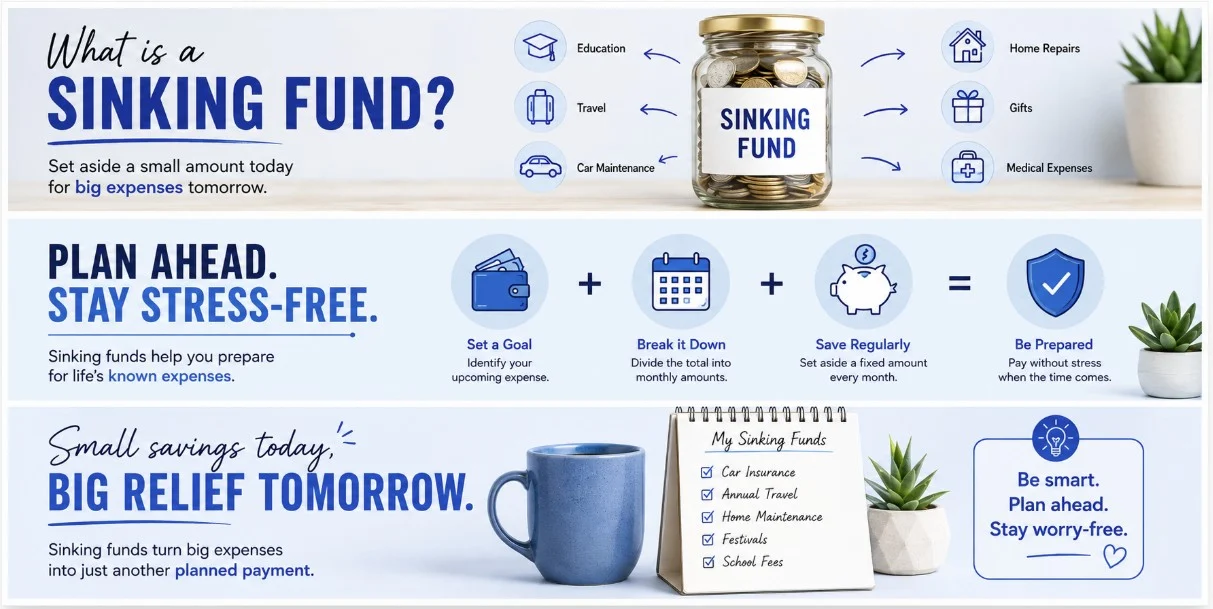
In simple terms, a sinking fund is money set aside for a particular known expense that is coming up in the short term or almost repeats every year.
The best candidates for a sinking fund are your yearly and recurring expenses. Insurance premiums, school fees, subscriptions and annual renewals, festivals, travel, and car or home maintenance. You know they are coming, and most of them are recurring expenses.
Here is a simple example. Your car insurance of ₹18,000 is due once a year. Instead of one painful bill, you save ₹1,500 a month, and the money is ready when the renewal arrives.
Sinking Fund vs a Financial Goal (an Important Line to Draw)
This is one point several people miss, because of which their finances never stay organized (even with a sinking fund).
You need a sinking fund for expenses you live with every year or need in the short term. Eg., Electricity bills, insurance payments, vacation expenses, etc.
A big one-time expense like a marriage, car purchase, etc. is, however, better planned under a long-term financial goal.
Mixing these funds soon becomes messy and confusing. So use a simple rule. Yearly and short-term expenses go to sinking funds. Big one-time expenses become financial goals of their own. We will come back to this when we talk about your larger financial plan.
Sinking Fund Meaning
Quick note on the words, because they confuse people. In company finance, “sinking fund” also means money a business sets aside to slowly repay a big loan or bond. That is the accounting meaning.
For your personal money, the meaning is much more straightforward. A sinking fund is just planned saving for a known, repeating expense.
Sinking Fund Example
Let us make it real with everyday yearly expenses.
- Your car insurance of ₹18,000 is due in 12 months. Save ₹1,500 a month, and it is covered.
- Diwali and festival spending will cost about ₹40,000. Start 10 months early, and ₹4,000 a month gets you there.
- Your yearly OTT, gym, and app renewals add up to ₹24,000. That is ₹2,000 a month set aside.
Notice the pattern. Thus, you save or debit (₹1,500 + ₹4,000 + ₹2,000) ₹7,500 into your sinking fund account each month. Thus, a large bill now becomes easily manageable with a sinking fund account set in place.
What is a Sinking Fund Account?
As the name suggests, a sinking fund account is a separate account created for the purpose of managing your sinking funds. The only condition is that it needs to be a separate account from your savings account, which is for your daily expenses. The easiest way is to create a separate savings account for this purpose or allocate any one debt mutual fund scheme.
What Are the Benefits of a Sinking Fund?
Avoids Impulsive Buying: When you plan for recurring expenses like school fees or insurance premium payments and set a budget beforehand, it avoids impulsive buying and promotes healthy spending habits.
Reduced Borrowing: You can avoid paying bills on credit or taking a loan to meet known expenses.
Better Cash Flow Management: Instead of taking a loan for a big purchase, your financial discipline ensures that expenses are planned ahead.
Peace of Mind: You stop dreading the expenses for a huge buy and stop procrastinating goals like buying a new car. A sinking fund lets you finally say, “We have the money; it is set aside for this goal; it is okay to spend it.
Comprehensive Financial Planning: The real win is when your sinking fund, emergency fund, and long-term financial goals work together to create a complete financial plan that works for you instead of against you.
Must Read: A Good Financial Plan Can Make Your Money Dreams Come True! Let’s Plan 2026
Sinking Fund vs Emergency Fund (vs a Savings Account)
Sinking fund: This is money set aside for recurring known yearly expenses, e.g., Insurance payments, school fees, OTT subscription payments, payments for yearly trips, etc. Most things we call “emergencies” are not emergencies at all. Your car will need servicing. Your fridge will die one day. These are all predictable. Importantly, things that aren’t an emergency shouldn’t come out of your emergency fund but out of your sinking fund.
Emergency Fund: This is money set aside for unexpected expenses like job loss, chronic health issues, or medical emergencies that require sudden cash, major repairs, etc. Do not drain your emergency fund for known expenses–else when a real emergency arrives, you will be left with no funds. Importantly, always fill the gap created in the emergency corpus due to utilization of the fund, so that you are ready for the next emergency.
Know More: Emergency Fund – Where to Invest and Why Build an Emergency Fund?
Savings Account: This is just a place for your daily expenses apart from planned expenses. After setting aside money for your regular monthly expenses, you can invest the remaining amount as per your financial goals.
Note: A financial plan is different from a financial goal. A financial plan is comprehensive and takes care of all your needs, including insurance, an emergency fund, and financial goals like child higher education, retirement, etc. For example, buying a car can be a financial goal for Ravi, while planning for her kid’s higher education for Ananya.
The financial plan includes a specific person’s financial goal, the number of years remaining to realize the goal, and the specific person’s financial capacity to achieve them. Two people can have the same financial goal, but the goal amount always differs, so two financial plans can never be the same. A customized financial plan helps you save and invest better as per your needs and risk appetite.
Here is a comparison to help you understand better
| Feature | Sinking Fund | Emergency Fund | Savings Account |
|---|---|---|---|
| Purpose | A known, repeating expense | Unexpected crises | Daily expenses |
| When you use it | On a planned date | Only in a real emergency | Whenever needed |
| Example | Insurance, festivals, travel | Job loss, hospital | Snacks, daily travel, fuel costs, etc |
Quick Note: Build your emergency fund first. A sinking fund is the next step, not a replacement. You need both, doing their two different jobs.
How to Create a Sinking Fund in 4 Simple Steps
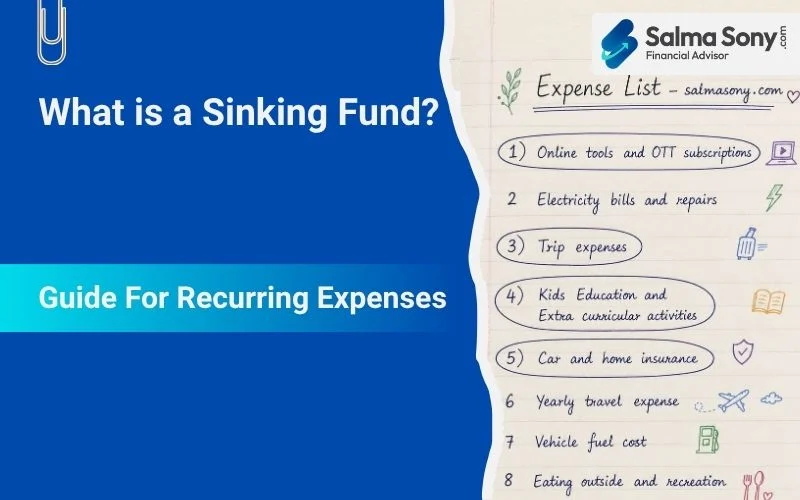
Creating a sinking fund is not a complex task. It starts with brainstorming and listing everything you spend on in a year. Then you need to circle the large expenses that do not come every month, like insurance, festivals, school fees, car service, or a trip. Those highlighted items are your sinking funds. In other words, budget first, spot the big-budget yearly expenses, and make them part of the sinking fund corpus.
Once you can see them, the rest is easy. One person said it took “30 minutes to set up, then it’s automated.” Here is the process for each fund.
- Name the expense: Be specific. Not “some savings,” but “car insurance, ₹18,000.”
- Set the timeframe: When do you need the money? In 10 months? Next April?
- Calculate the monthly amount: Divide the cost by the number of months. Add a small buffer for price rises.
- Automate it: Set a standing instruction on your salary date, so the money moves before you can spend it.
That is it. Do this once, and it runs on autopilot.
How Much Should You Need to Save Each Month?
Now, which savings instrument should you use for each goal? The answer depends on whether the goal has a fixed deadline or a flexible one.
Option 1: A recurring deposit (RD) or Debt / Arbitrage mutual fund (best for fixed-date goals that earn a little extra)
Take Rahul. His daughter’s annual school fee of ₹60,000 is due in 12 months. He opens a recurring deposit at 6.5% and sets it to pull ₹4,850 every month. After 12 months, his deposits plus interest add up to about ₹60,000, ready exactly when the fee falls due. The money is locked away from daily spending, and it earns interest while it waits. This suits goals with a clear deadline, like an insurance premium or a school fee. However, it can be confusing if you have more than 3 such recurring expenses. It’s better to allocate one debt mutual fund scheme for all recurring expenses and withdraw as and when needed.
Option 2: A separate savings account (best for flexible goals you may dip into)
Take Meera. She wants ₹30,000 ready for Diwali, ten months away. She opens a second savings account, names it “Diwali,” and sets a standing instruction of ₹3,000 a month. It earns low interest, but that is not the point. The money is ring-fenced and out of sight, so she does not accidentally spend it. After ten months, ₹30,000 is sitting there, and she can withdraw it any time with no lock-in. This suits goals where you value easy access over interest, like festivals, gifts, or a short trip. Activate Sweep-in and Sweep-out FD to earn like an FD & keep it accessible like asavings bank balance.
A simple rule of thumb: If the date is fixed and far enough away, use a recurring deposit or mutual fund and earn more interest than a savings account. If the amount is small and you want instant access, a separate savings account keeps it flexible and stress-free.
Here is a sample to help you understand better:
| Item | Budget Needed | No. of Months Left for Purchase | Savings Method |
|---|---|---|---|
| Online Tools and OTT Subscriptions | ₹12,000 (Netflix, Prime, Spotify, Canva, etc.) | 12 months (renews yearly) | Mutual fund, or Recurring deposit, set aside ₹1,000/month |
| Trip Expenses | ₹1,50,000 (annual family vacation) | 10 months | Mutual fund, or Recurring deposit, set aside ₹15,000/month |
| Kids Education and Extra Curricular Activities | ₹80,000 (school fee + classes/sports) | 8 months | Savings bank or Mutual fund, set aside ₹10,000/month |
| Car and Home Insurance | ₹24,000 (car ~₹18,000 + home ~₹6,000) | 12 months (renews yearly) | Mutual fund, or Recurring deposit, set aside ₹2,000/month |
| Home Loan Payments (yearly prepayment) | ₹1,20,000 (annual part-prepayment to cut interest) | 12 months | Mutual fund, or Recurring deposit, set aside ₹10,000/month |
| Yearly Travel Expense (flights home) | ₹96,000 (annual trip to hometown/abroad) | 12 months | Mutual fund, or Recurring deposit, set aside ₹8,000/month |
| New Phone Expenses | ₹80,000 (upgrade every ~2 years) | 18 months | Mutual fund, or Recurring deposit, set aside ₹4,500/month |
Note: Here, I have used a savings account for short, flexible expenses like school fees, where schools usually ask for quarterly fee payments. And for annual expenses, we are using either mutual funds or a recurring deposit so that the money earns a little while it waits. At maturity, the RD amount will be credited to the same savings account (sinking fund account) for making payments; for mutual funds, you will have to redeem as per the requirements and make the payment.
Common Sinking Fund Categories
If you are still confused about which of your expenses should go to a sinking fund, here are some common examples.
1. School Fees and Annual Insurance Premiums
School fees come once or twice a year. Car and health insurance renew yearly. These are big, fixed, and easy to see coming. A fund for each means the date arrives, and you simply pay calmly, without scrambling for the money.
2. Car and Home Maintenance (Service, Repairs, AMC)
Your car needs a yearly service. Your home needs repairs. Your AC, fridge, and washing machine need an AMC (annual maintenance contract, a yearly repair plan). These bills are not monthly, but they are certain. A maintenance fund means a sudden ₹15,000 service bill comes out of a jar you already filled, not your salary.
3. Subscriptions and Annual Renewals
Netflix, Prime, Spotify, your email storage, a design tool. Many of these charge once a year, and the bill always feels like a surprise. Add them up and save a little each month. When the yearly renewal hits, the money is ready and waiting.
4. Travel or Vacation Fund
A holiday is a want, not an emergency. So plan for it. Decide the trip, the rough cost, and the date. Then save towards it every month. You get to enjoy the trip fully, with no credit card bill chasing you afterward.
Where Should You Keep Your Sinking Fund Money in India
Since the money in a sinking fund is for expenses that come once a year, or a little over a year away, your money does not need to grow aggressively. It just needs to be safe and ready on the day. Here are your three choices, from simplest to smartest.
1. A Separate Savings Account
The easiest option. Open a second savings account, name it for the goal, and set a monthly standing instruction.
- Best for: small or short-term goals (subscriptions, insurance, festivals).
- Returns: low, around 3% to 4% a year.
- Why use it: instant access, zero effort, and the money stays out of sight so you do not spend it.
2. A Liquid Fund
A liquid fund is a type of mutual fund that holds very safe, short-term investments. Think of it as a savings account that works a little harder.
- Best for: medium-term goals (a trip, school fees, a new phone).
- Returns: usually around 5% to 6% a year, a bit more than a savings account.
- Why use it: you can withdraw within a day, and it beats idle cash. There is very low risk, though not fully guaranteed like a bank deposit.
3. An Arbitrage Fund
An arbitrage fund is another low-risk mutual fund, but it is taxed like an equity fund, which can mean less tax if you hold it for over a year.
- Best for: bigger goals a year or more away, especially if you are in a higher tax bracket.
- Returns: similar to a liquid fund, around 5% to 6%, but often more tax-friendly.
- Why use it: The tax treatment can leave you with more in hand on longer goals.
Also Read: 5 Mutual Fund Types: Learn to choose the right fund for you
| Your fund needs | Best place to keep it |
|---|---|
| Small, or needed within months | Separate savings account |
| Medium, needed in 6 to 14 months | Liquid fund |
| Larger, over a year away, higher tax bracket | Arbitrage fund |
The simple rule:the sooner you need the money, the safer and more accessible it should be. Never chase high returns with a sinking fund. Its job is to safeguard the principal and liquidity- be ready on the day you need it, not to grow fast. It is also important to match your goal to the right investment type, as shown above. More on this in the Financial Planning section.
One Account or Many? How to Organize Your Sinking Fund Account and Track It?
You do not need a separate bank account for each sinking fund goal. Manage all your sinking funds and investments in a single account.
There is one point that confuses every beginner. When you spend from a sinking fund, does it count as an expense that month? The clean way to handle it: log the expense as normal, and also record the money coming in from your fund to cover it. That way your month does not look like you suddenly overspent. Some months will naturally be heavier, and that is fine. It balances out over the year.
Quick Note: Do not create a fund for every tiny thing. Small, regular costs can just live in your monthly budget. Sinking funds are for the bigger yearly bills, and separate financial goals are for the bigger one-time expenses (that are predicted in the next 3 years onwards).
Disadvantages of a Sinking Fund if Not Planned Well
A good guide tells you the downsides too. Sinking funds are not perfect in the following situation.
- Idle cash loses value: Parking large amounts of money in a low-interest account for years means inflation slowly eats your savings. Thus, use sinking funds only for yearly expenses.
- They are wrong for long-term goals: Saving for your child’s college in 15 years? That is an investing goal, not a sinking fund goal. Hence, ensure the right allocation.
- Too many funds create clutter: A dozen tiny funds can feel like a chore and leave money scattered and unused. So don’t scatter; allocate one fund, and it does the job perfectly.
- They need discipline: If you are not careful, the money “piles up in your account and gradually disappears through spending. This can be eliminated by investing rather than parking in savings bank account.
Here is the simple rule to remember. A sinking fund is a dedicated fund for yearly expenses. For any longer tenure goal, treat it as a long-term financial goal.
What is a Long-term Financial goal, and how is It Different From a Sinking Fund?
Sinking funds can work well for expenses that come back every year. But you also have other expenses that are just as predictable but just need far more savings to realize the goal. These often happen only once, with a timeframe of any time between 6 months and more.
- Planning for your kids’ higher education (in the USA or UK)
- Buying a new home
- Planning for your kid’s wedding expenses
- Building your retirement fund
- Buying a car
Why do these need separate planning for these financial goals?
Because mixing a ₹1 crore wedding cost with a ₹15,000 yearly insurance payment only creates confusion. So we can define a financial goal as any long-term expense that needs a much larger amount than a sinking fund and a much longer time to save for.
For goals like these, the sooner you start, the smaller your monthly investment amount and the more you can invest in higher-growth funds by taking risk based on your risk appetite. And if the goal is a few years away but a one-time expense, you must invest for it in safer funds like a debt/arbitrage fund rather than keep it all in cash. More on that next.
How Sinking Funds Fit into Your Larger Financial Plan?
Financial Goal:A financial goal is for a longer tenure and a larger target, like retirement planning or your kids’ higher education. The amount needed to reach the goal is very high and needs proper financial planning to match the right funds to your goal.
Sinking Fund: A sinking fund is a fund for expenses that recur yearly, within 1 to 3 years. For example, OTT payments, home appliance repairs, or expenses for a cousin’s wedding.
Emergency Fund:This is for unplanned expenses, like a job loss or a sudden medical emergency.
Savings Fund: This is for your everyday expenses, like fuel, daily travel, and kids’ extracurricular activities.
You need to save money in this order. First, your money must go into an emergency fund. Then into your yearly sinking fund expenses, so these do not get paid on credit. And then into your long-term financial goals.
Emergency Fund → Sinking Fund → Long-term Financial Goal
A complete financial plan should account for all these types of expenses and match the right investment to the right goal. For example, a sinking fund can be managed with debt funds or a savings account, while a long-term financial goal can be saved via equity funds and PPF, because the tenure is long and you can invest in funds with a longer maturity.
A SEBI-registered financial adviser is the right person to give you clarity on your finances, especially if you have a specific goal like retirement planning or investment planning for your kids.
Here is how that mapping looks in practice.
| Your money needs | Type | Where it belongs |
|---|---|---|
| Sudden job loss or medical crisis | Emergency Fund | FD/ Liquid/Arbitage fund |
| Fuel, daily travel, kids’ activities | Savings Fund | savings account |
| Insurance, school fees, festivals, travel | Sinking Fund | Savings / RD/ Liquid/Arbitage fund |
| Kids’ higher education (USA or UK) | Long-term goal | Mix of equity and debt funds |
| Buying a new home | Long-term goal | Mix of equity and debt funds |
| Kid’s wedding expenses | Long-term goal | Mix of equity, debt and gold funds |
| Building your retirement fund | Long-term goal | Equity mutual funds, PPF, NPS |
| Buying a car | Long-term goal | Mix of equity and debt funds |
Of course, it is not as simple as it sounds. A customized financial plan can help you tap into the right instruments that you have never even heard about. For example, did you know REITs are investments in real estate that let you invest a small amount into property so you can start building towards a regular income stream (suitable for retirees) without buying a whole flat upfront?
Read More: How to Invest in REITs in India
Also, if your child will study in the USA or UK, remember that the fees are billed in dollars or pounds, not rupees. By investing for part of this goal in US stocks (or a US-focused fund), your money grows in dollars instead of rupees. So when the rupee falls against the dollar, your investment rises to match it, and you save in dollars, which is how you will pay for your kids’ education abroad.
Additional Read: Invest in US Stocks From India
Thus, a good financial adviser does more than organize your goals. They open the door to instruments you may never have heard of, from REITs to US equity funds to tax-smart debt options, that can quietly save you a great deal, especially when you are saving for a long-term goal
Practical Takeaways:
- Open your budget and list every expense that comes yearly, not monthly. Those are your sinking fund candidates.
- For your biggest sinking fund, do the math (cost divided by months) and set an automatic transfer on your salary date.
- Check that your emergency fund exists first. That always comes before sinking funds and long-term financial goals.
- For any goal more than three years away, like a child’s higher education, plan to invest for it rather than keep it in a savings account
- Separately, list your big one-time goals (kid’s wedding, a luxury car, etc.). Keep them apart from the yearly list.
The Bottom Line
“What is a sinking fund?” has a simple answer. A sinking fund is money you set aside a little at a time, each month, to pay for a large but predictable expense that does not come every month. Instead of facing the full cost all at once, you save towards it in advance. Common examples include insurance premiums, school fees, car service, festivals, and annual subscriptions.
The right first step is not to open five new accounts. It is to see your full money picture and decide what each rupee is for. A right financial advisor can help you do exactly that, without the overwhelm and uncertainty of planning everything alone.
FAQ: What is a sinking fund?
Q-1: What is a sinking fund ?
It is money you set aside little by little for a known expense that repeats every year or is coming up soon. Think of it as a mini savings pot with a clear job, like “car insurance” or “school fees.” Instead of one painful bill, you pay for it in small, easy monthly amounts. When the expense arrives, the money is already there, so you avoid debt and stress.
Q-2: What is the purpose of a sinking fund?
he purpose is calm and control. It turns a scary, lumpy bill into a planned, boring one. It stops you from reaching for a credit card or breaking a fixed deposit when a known expense lands. It also protects your emergency fund, because you are not using it for costs you could see coming. In short, it removes the panic from big, predictable, repeating expenses.
Q-3: Should I use a sinking fund for a wedding or a baby?
Not exactly. A wedding or a baby is a big, one-time expense, usually more than a year away, so it is cleaner to treat it as its own financial goal, with its own separate account. Use sinking funds for your yearly, repeating bills like insurance and school fees. Keeping the two apart stops your money from becoming a confusing single pile. The saving habit is the same, the label and the account are different.
Q-4: What is the difference between a sinking fund and an emergency fund?
A sinking fund is for expenses you know about and that repeat, like insurance or a yearly trip. An emergency fund is for things you cannot predict, like a job loss or a medical crisis. Keep them separate. If you spend your emergency fund on a planned expense, you will have nothing left when a genuine emergency hits.
Q-5: How much money should I put in a sinking fund?
Take the total cost and divide it by the number of months until you need it. For example, ₹18,000 of insurance due in 12 months means ₹1,500 a month. Add a small buffer in case prices rise. For open-ended sinking funds like car maintenance, just save a steady amount each month and let it grow.
Q-6: Where should I keep my sinking fund money in India?
For yearly bills and short-term needs, a separate savings account or a recurring deposit works well. A sweep-in fixed deposit earns a bit more while staying accessible. For goals one to three years away, consider a liquid or arbitrage mutual fund, which usually beats a savings account and gives your money back within a couple of days. Match the option to your timeline.
Q-7: How many sinking funds should I have?
As many as give you clarity, without leaving too much cash sitting idle. Some people run 15 or more; others keep just four or five core ones. There is no perfect number. Start with your two or three biggest yearly expenses and add more only if it genuinely helps you stay organized.